Quahog shell · Museum specimen photograph by Emőke Dénes · CC BY-SA 4.0
Aquinnah, on Noepe · Photo: MarinelaK · CC BY-SA 4.0
Contemporary wampum beads · photographed in 2009 Maker: Elizabeth James-Perry Photograph: Mary Meredith · public domain
Material, skill & meaning
Purple from the shell.
Quahogs have purple and white shell. These beads were made by Aquinnah Wampanoag artist Elizabeth James-Perry. They show a living art, not a reproduction of a seventeenth-century belt.
Wampum has cultural meanings and relationships beyond exchange. Learn about those meanings from the Tribe and the people who make it.
Noepe is a Wampanoag name for Martha’s Vineyard. Aquinnah is a Wampanoag community on its western end. The Wampanoag Tribe of Gay Head (Aquinnah) is a sovereign tribal nation—a people with its own government. A tribal government is different from a town government. Read the Tribe’s own history ↗
Wampum carries meaning
Wampum is made from shell, including purple and white quahog shell. It has been used in exchange and in important cultural relationships and records. Calling it only “money” leaves out much of its meaning. Wampanoag artists work with wampum today. Learn from the Tribe ↗
A museum with a voice
The Aquinnah Cultural Center shares Wampanoag history, culture, and arts. Its museum at 35 Aquinnah Circle offers a place to learn from Wampanoag educators. Past exhibitions have featured Julia Marden’s weaving and the work of Gladys, Donald, Heath, and Jason Widdiss. Aquinnah Cultural Center ↗
Caring for cultural places
The Tribe’s Historic Preservation Office works to protect cultural places and ancestors. Archaeology involves responsibilities to living communities. If you see something that might be an artifact, leave it in place and tell a trusted adult or the appropriate land manager. Tribal Historic Preservation Office ↗
Skills & knowledge
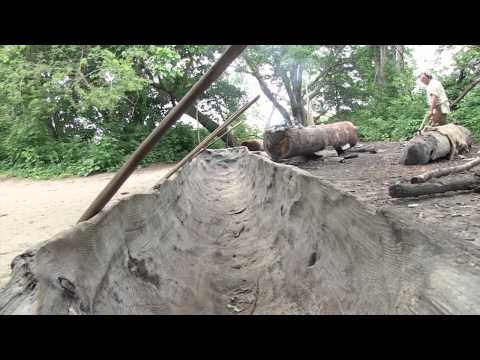
A canoe is more than transportation.
This modern museum photograph shows canoe making at Plimoth Patuxet. It helps us ask about tools, trees, waterways, and teaching. It is not a photograph from the 1600s.
What knowledge would a maker need? Which answers could the photograph support, and which would require speaking with a knowledgeable educator?
Mishoon is the spelling used in these museum and public-media resources. The plural is mishoonash. Watch skilled makers connect wood, water, tools, and community.
Watch with an adult. Do not try this on your own. Mishoon making uses fire, hot materials, and sharp tools. Do not light fires, cut wood, or use carving tools without direct supervision from a qualified adult. These films are for observing skilled makers, not a student do-it-yourself assignment.
Rhode Island PBS / Ocean State Media · 9:59
Mishoon: knowledge carried forward
A Native artist and crew share Wampanoag boat-building knowledge in Little Compton, Rhode Island. This is a living tradition, connected to Wampanoag communities across the region.
How does a boat connect people with waterways and one another?
What shows that Wampanoag knowledge continues today?
Plimoth Patuxet / PACTV · 8:31
Paddling Through History
Follow a mishoon-making project shared in Plimoth Patuxet’s teacher toolkit. The museum recommends this film for grades 5 and up; for this class, an adult should preview it and choose a short excerpt.
What can this film teach that a still photograph cannot?
What question would you ask a Wampanoag boat maker?
Videos do not start automatically. Use the player’s caption and full-screen controls. If a school network blocks a player, use its publisher link.
After the Mayflower
Watch with your teacher. This full documentary contains disturbing accounts and images of disease, war, enslavement, and death. Teachers: preview it and select brief, age-appropriate excerpts for third grade. Pause to explain unfamiliar words and make time for questions.
PBS / American Experience · 2009 · About 73 minutes · teacher-selected excerpts
We Shall Remain · Episode 1: After the Mayflower
This documentary follows Wampanoag and English relationships from the 1621 alliance made by Ousamequin (Massasoit) through the conflict known as King Philip’s War. It examines why leaders made difficult choices as disease, growing English settlements, and demands for land threatened Native communities. Native voices, historians, and reenactments help tell the story. Wampanoag history continues today.
The Aquinnah Tribe gained federal recognition in 1987. That formal relationship with the U.S. government followed generations of Wampanoag community life and years of work by tribal citizens. Native nations existed long before the United States.
Meet two Wampanoag girls and explore connections between their lives today and the history shared at the museum. Present-day Wampanoag people have modern lives as well as deep connections to their communities’ traditions.
An Aquinnah Wampanoag artist: Elizabeth James-Perry
Meet an Aquinnah Wampanoag artist whose work connects wampum, plant fibers, family knowledge, and the land. Look for evidence of a living tradition that continues to grow.
How can art carry knowledge from one generation to another?
What would you ask the artist about her work?
MacArthur Foundation · Short profile · 2010
Jessie Little Doe Baird: bringing language home
Listen to Mashpee Wampanoag linguist Jessie Little Doe Baird describe language reclamation. Her work connects to several Wampanoag communities, including Aquinnah. Read about the project’s continuing work on its own website.
November 21, 2019 · English audio · 49 minutes, 28 seconds
CAI’s discussion features Wampanoag educator David Vanderhoop and historian David Silverman. They examine how the 1621 gathering became a national story and ask what familiar Thanksgiving accounts leave out.
Audio streams from CAI’s published recording. No autoplay. The overview here is a summary, not a transcript.
For teachers and families
Preview this full-length discussion and choose a short excerpt for younger learners. Pause to explain unfamiliar words and discuss colonization and harm with care. The English recording does not change when you switch the site’s language.
For a reading option, use the Plymouth & Patuxet lesson and its source lab. These are companion materials, not a transcript of this recording.
 Noepe · Aquinnah · Living nations




 Plimoth Patuxet Museums
 Native Knowledge 360°: Thanksgiving
